Best Time to Take Creatine: Before or After Your Workout?
powergenx6 · 7 Aug 2026
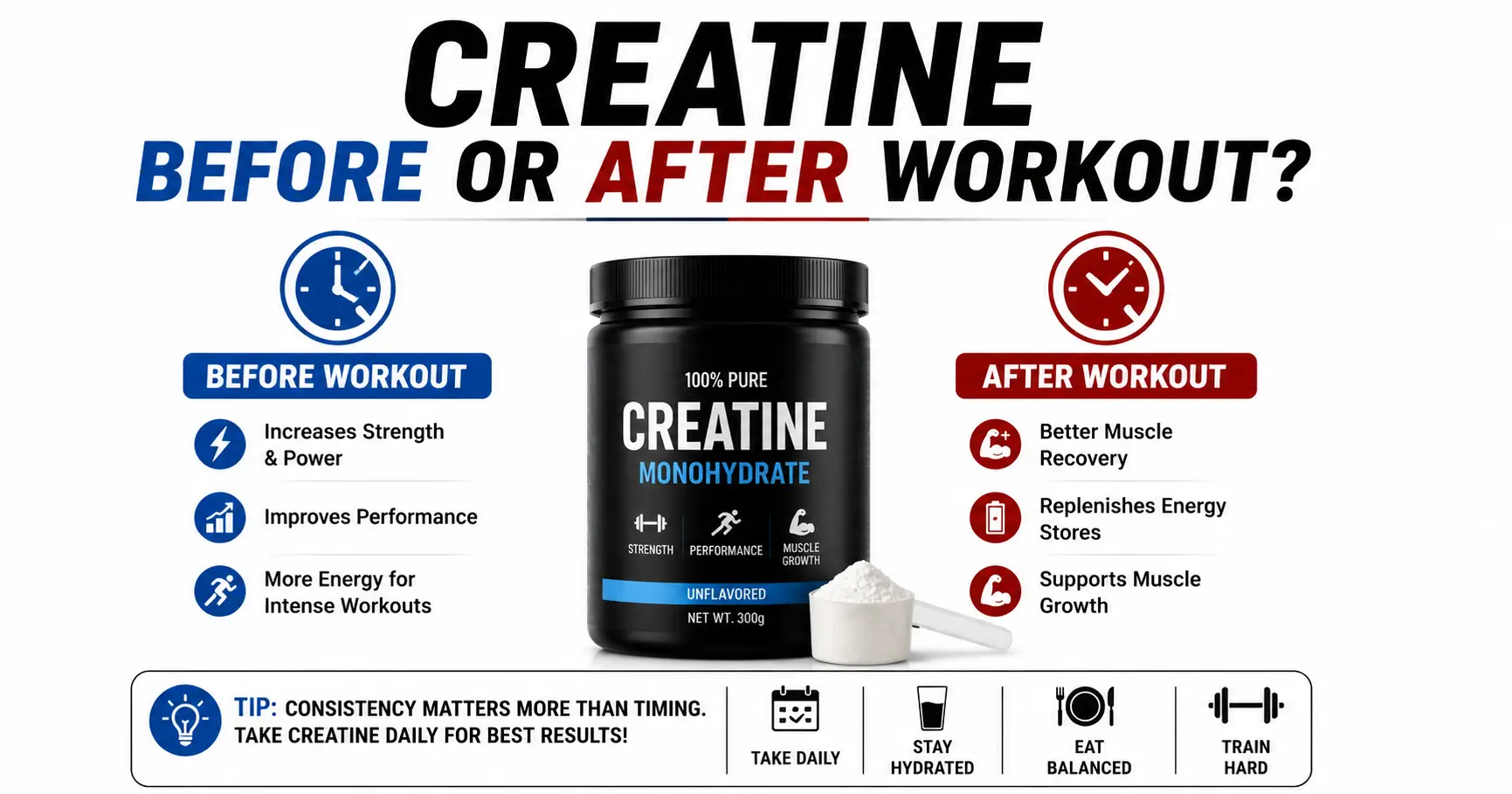
Introduction
You just bought a tub of creatine. You mix your first scoop, and then a question hits you: should I drink this before I lift, or after?
If you Google it, you’ll find a hundred different opinions. Your gym buddy swears by pre-workout dosing. Your favorite fitness influencer takes it right after training. Some articles even suggest sipping it during your workout.
So who’s right?
Here’s the short answer: timing matters far less than you’d think. What actually moves the needle is something much simpler showing up every single day. But that doesn’t mean timing is completely irrelevant. There’s real science behind this debate, and once you understand how creatine actually works inside your muscles, the “before vs after” question becomes a lot easier to answer.
In this guide, we’ll break down what creatine does in your body, what the research really says about timing, and how to build a routine that actually gets you results without the confusion.
What Is Creatine and How Does It Work?
Creatine is one of the most researched and trusted supplements in the fitness world. Your body naturally makes small amounts of it in the liver and kidneys, and you also get some from foods like red meat and fish. But most people supplement with creatine monohydrate because it helps push your muscle stores higher than diet alone can.
Here’s the science in simple terms: your muscles use a molecule called ATP (adenosine triphosphate) for quick bursts of energy think heavy squats, sprints, or explosive jumps. ATP runs out fast, within seconds. Creatine helps regenerate ATP quickly by donating a phosphate group through something called the phosphocreatine (PCr) system.
In plain English: more creatine stored in your muscles means more quick-energy fuel available, which can translate into a rep or two extra, slightly faster recovery between sets, and over time, more strength and muscle growth.
This is exactly why the timing debate exists. If creatine helps fuel performance, wouldn’t it make sense to take it right before you need that energy? Or would taking it after training, when your muscles are primed to absorb nutrients, work better? Let’s look at what the actual studies found.
The Case for Taking Creatine Before a Workout
The “before” camp argues that having creatine already circulating in your bloodstream before you start lifting means your muscles have quicker access to it right when you need it most during your heaviest sets.
The theory is similar to how some people time their pre-workout caffeine or carbs: get the fuel in early so it’s ready to work when your muscles start demanding energy.
However, it’s worth noting that creatine doesn’t work like caffeine. It doesn’t give you an instant energy spike. Its benefits build up over days and weeks as your muscle creatine stores become saturated. So while pre-workout dosing sounds logical on paper, the acute effect of taking it “just before” training is minimal, since creatine already in your muscles (from previous days) is doing most of the work during that session.
The Case for Taking Creatine After a Workout
The “after” camp has slightly stronger science behind it at least in one well-known study.
A 2013 study published in the Journal of the International Society of Sports Nutrition, led by researchers Antonio and Ciccone, tested recreational male bodybuilders who took 5 grams of creatine either right before or right after their workouts for four weeks. The group that took it after training showed a bit more improvement in lean body mass and strength compared to the pre-workout group.
The theory behind this is that after a workout, blood flow to your muscles increases, and your muscles become more receptive to nutrient uptake a bit like how post-workout protein and carbs are often recommended to support recovery. Some researchers believe exercise may also temporarily boost the activity of creatine transporters in muscle cells, helping more creatine get absorbed where it’s needed.
That said, this study was small, short (just four weeks), and the results, while favoring post-workout timing, weren’t dramatically different between groups.
What Does the Research Actually Say? (Before vs After)
This is where things get interesting. While the 2013 study hinted that post-workout timing might have a slight edge, later and larger studies tell a different story.
An 8-week study published in Frontiers in Sports and Active Living, involving both male and female college athletes, directly compared pre- and post-workout creatine supplementation alongside protein and carbs. The result? No meaningful difference in strength, muscle growth, or body composition between the two groups.
Similarly, a study by Candow and colleagues, which looked at healthy older adults over a longer training period, also found no real advantage of one timing strategy over the other.
Here’s a simple comparison table to make sense of it all:
| Study | Duration | Comparison | Result |
| Antonio & Ciccone (2013) | 4 weeks | Before vs. after workout | Slight edge for post-workout (small sample, short duration) |
| Candow et al. (2014) | Longer-term, older adults | Before vs. after workout | No meaningful timing difference |
| Dinan et al., Frontiers (2022) | 8 weeks | Before vs. after workout (with protein + carbs) | No meaningful difference in strength or body composition |
The takeaway from the research as a whole: any advantage of one timing over another is small, inconsistent, and easily outweighed by other factors especially consistency.
Does Timing Even Matter? The Role of Consistency
Here’s the part most people miss: creatine doesn’t work through a single dose giving you an instant boost. It works by building up, or “saturating,” your muscle stores over time.
Think of your muscles like a water tank. Creatine slowly fills that tank day after day. Once it’s full (usually within a few weeks of consistent use), your muscles have a steady supply available for every workout regardless of what time you took your last dose.
This is why researchers increasingly agree that the timing question is almost a distraction from what actually matters: taking your creatine every single day, without gaps. Missing days here and there, or obsessing over the “perfect minute” to take it, does far more damage to your results than choosing morning over evening, or before over after.
Best Practices for Taking Creatine
If you want to get the most out of your creatine supplementation, here’s a simple, no-nonsense approach:
- Daily dose: Stick to 3–5 grams of creatine monohydrate every day.
- Loading phase (optional): Some people choose to “load” with 20 grams per day (split into 4 doses) for the first 5–7 days to saturate muscles faster. This isn’t necessary taking 3–5g daily will get you to the same saturation point in about 3–4 weeks.
- Pair it with carbs or protein: Taking creatine alongside a meal that has carbohydrates or protein may slightly improve absorption, since insulin release can help shuttle creatine into muscle cells.
- Rest days matter too: Keep taking your creatine on rest days. Your muscles are still building and recovering, and consistent intake keeps your stores topped up.
- Stay hydrated: Creatine draws water into your muscle cells, so make sure you’re drinking enough water throughout the day.
- Pick a time you’ll stick to: Whether that’s with breakfast, right after your workout, or before bed the best time is the time you won’t forget.
Common Mistakes to Avoid
Even with a supplement as simple as creatine, people manage to overthink it. Here are a few common mistakes:
- Obsessing over exact timing instead of daily consistency. As we’ve covered, this is the single biggest factor people get wrong.
- Skipping rest days. Creatine isn’t just a “workout day” supplement your muscles need it every day to stay saturated.
- Not drinking enough water. Since creatine pulls water into your muscles, dehydration can lead to cramping or discomfort.
- Expecting overnight results. Creatine’s benefits build gradually over 2–4 weeks. Don’t expect a single dose to transform your lifts.
- Assuming more is better. Taking more than the recommended 3–5g daily doesn’t speed up results your body can only store so much.
Frequently Asked Questions
Can I take creatine on an empty stomach? Yes, you can. Creatine doesn’t require food to be effective, though taking it with a meal containing carbs or protein may slightly help absorption.
Should I cycle creatine (take breaks from it)? No, cycling isn’t necessary. Creatine is safe for long-term daily use, and cycling can actually cause your muscle stores to drop below optimal levels.
What happens if I miss a day? Nothing dramatic your muscle creatine stores stay saturated for a while. Just get back to your daily routine as soon as you remember.
Is creatine safe for long-term use? Yes. Creatine monohydrate is one of the most studied supplements available, and research consistently supports its safety for healthy adults when taken at recommended doses over long periods.
Conclusion
So, before or after your workout which one should you choose?
Based on the research, the honest answer is: it really doesn’t matter much. A handful of studies show a slight lean toward post-workout timing, while others find no difference at all. What every single study agrees on, though, is that daily consistency is what actually drives results.
Instead of stressing over the clock, pick a time that fits naturally into your routine one you’ll actually stick to for weeks and months, not just a few days. Pair it with a balanced diet, stay hydrated, and keep training hard. That combination will do far more for your strength and muscle gains than perfecting your supplement timing ever will.
Try it for yourself: commit to taking 3–5g of creatine daily for the next 4–6 weeks, at a time that works for you, and track your strength and progress. You’ll likely find that showing up consistently is the real secret not the clock.